Monday, February 24, 2014

PARROT FEVER

Have you ever heard of psittacosis?  It's a bacterial infection carried by birds such as parrots, macaws and  other birds that can be transmitted to humans. Back in 1929 a large and highly publicized outbreak of what was then termed "parrot fever" occurred in the US.  It led to greater controls on the import of pet parrots and actually had a hand in creating today's National Institutes of Health..aka the NIH.

No, we are NOT suffering from that malaise, which is treated these days with antibiotics.  However, we are somewhat afflicted with a form of parrot fever that involves chasing down, observing, listening to and photographing the feral populations of parrots that live here in the Rio Grande Valley.

Lilac-crowned Parrot, Brownsville, Texas
I'm sure you've heard of or seen the film The Wild Parrots of Telegraph Hill about the feral parrot populations of San Francisco..but you may not know that many feral populations exist in other states too including southern Texas.  Here in the Rio Grande Valley, three well known populations exist; in Harlingen, McAllen and Brownsville...but there's another big population in Austin, too.

More often than not,   our experiences with parrots have come via a pet shop or zoo or a friend who might have posessed a parrot for decades... unless you've been lucky enough to visit the tropics where they fly and roam in the wild.  My first wild parrot flock sighting was in Panama. Hearing their shrill, grating calls as flocks gathered in the trees, and then seeing this group of intense green birds left me speechless and wanting to see more, more, more!!
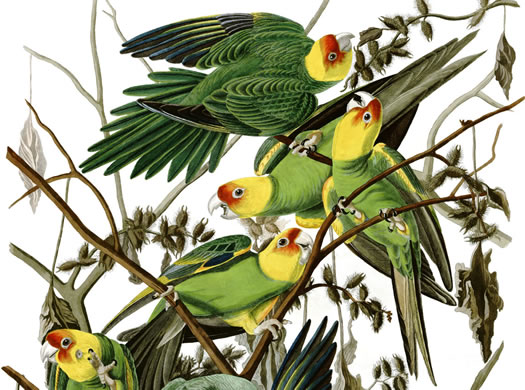
Audubon's Carolina Parakeets
 It may be hard to imagine now,  but wild parakeets were once common in the southeastern United States.  The Carolina Parakeet sometimes ranged as far north as Wisconsin and New York.  Their relentless persecution by farmers and those who killed them for their gloriously beautiful feathers led to their demise by 1920.  It's a sad story, that continues today, only this time the hunt is to supply pet shops,

Parrots are incredibly long lived, and very social birds. They have needs and issues, just as you would if you were taken from your family group, your native habitat and put in a cage for years.   It's little wonder people release them. It's a daunting responsibility to care for a social, demanding bird, who, among other things manifests its stress living in captivity by plucking out its own feathers,

One must arrive before dusk in Oliviera Park in Brownsville. You hear them long before you spot them, as they gather in small groups before roosting.The volume builds and they number in the hundreds as they raucously work out their family groupings for the night.
This particular evening, many fed furiously on low hanging tender tree buds.


As the sun sets, we quickly try to figure out how many different species we see. It's a challenge as they move about. Usually there are many Red-crowned, some Lilac-crowned and a just a few of the declining Yellow-headed Parrots.  Once they land in the eucalyptus trees, they blend and meld..but this pair was too busy grooming each other to notice us...and how could you NOT just adore them!! 
Red-crowned Parrot pair


So...our search and fever to find others, including finding the Green Parakeets in Harlingen: part of our bucket list of birding expeditions as we begin March, our last month in the Rio Grande Valley.


Monday, February 3, 2014

A Day in Our Volunteer Life

Here at the Refuge, we must each "work" twenty four hours per week, to receive the benefits afforded to volunteers, namely: trailer pad, hookups, shower and laundry facilities and the run of the place on our days off.  Sadly, budget cuts over the past few years have removed many of the paid positions at refuges and parks as staff transfers out to other locations.  Here at Laguna, there is a virtual army of volunteers; in the visitor services, maintenance and resource management divisions. It's a good deal for the refuge and for us.  However, it doesn't address the serious and perpetual decline in staff needed to operate this and many other federal areas around the country. For the refuge, and us it seems win-win as we trade our skills and desires for their needed  personnel to conduct birding tours during the January thru March high season.

So, here's a glimpse into one of our work days.  For us, it's just another excuse to go birding and meet people from all over the country.


Here in the "Volunteer Village" amidst the other RV's and TT's,  we head out from our little home away from home to retrieve our van for today's Birding Tour.


We check in at the Visitor Center before it opens to do a few chores.  Marion is our boss, and the "Lone Ranger" of Visitor Services at the Refuge....Note on the welcome sign that the visitor center is closed on Tuesdays and Wednesdays due to budget cuts...(and not enough paid staff to keep it open 7 days a week.. With the attrition of other positions, her job duties have grown enormously over the course of the four years she has been here.


After checking in visitors, we load up and set out for our destination:  Bahia Grande and the "Red Gate" tour. This is a special tour of an area normally closed to the public and only accessible  during a 3 1/2 hour birding tour scheduled 5 days a week.

The Bahia Grande (Big Bay) is a unit of the Refuge that is currently undergoing an intensive vegetation and coastal wetlands system restoration. At 9,000 acres, it is believed to be the largest restoration project of its kind currently underway in the United States.

A huge group of federal, state and regional partners have come together to restore these wetlands that have been dry for more than 30 years. With so much habitat loss here in south Texas, and wetlands in general, this will bring new life and hope for the many waterfowl, wading birds and shorebirds who depend upon them. Many of these are on the Texas and federal threatened and endangered species list.

Aside from an abundance of wetlands, native grasslands and open savannah will benefit the  Northern Aplomado Falcon, a bird that was once extirpated from the state due to habitat loss, pesticide use and hunting. Although their numbers are stable in Mexico, back in 1993 in partnership with the Peregrine Fund the first captive bred chicks were released on the Refuge. They continue to do well here, with about 25 pairs in south Texas, but they remain on the endangered list.

With so much water and the open space of the savannah, we will often count 30 or more bird species on the Bahia.  For many visitors, this falcon is a "life bird". On a trip last week, we not only had fantastic close up looks at the falcons, but an aerial display of two falcons harassing a pair of Chihuahuan Ravens ( I wonder if they understand Spanish?)  were a little too close for falcon comfort.  Leon got some great pics... and it made all of us bird nerds very happy!

Aplomado means "lead colored" in Spanish
Falcon "communicating" with the  Raven

Wednesday, January 22, 2014

The Madre & The Padre


The wind is up today, blowing strong from the north, making temps cooler and keeping the birds hunkered down; a good day for a new blog post!

Since last week we’ve done a bit of back road mountain bike exploring in the refuge.  Bow hunting season ended a week ago for white-tailed deer, feral pigs and exotic Nilgai (more on that creature later), so we are free to roam without fear of being a moving target. 


Leon’s quest for pictures of Redhead ducks took us to Horse Island at the north end of the Refuge. Any blondes or brunettes that show up would be a welcome sight, too.... ;-))  After eight miles of dirt road riding we arrive on a naturally elevated ridge of yucca and thicket; one of the very few places with a viewpoint over the Laguna Madre: the only hyper-saline coastal lagoon on the N. American continent. 
View from Horse Island looking south across part of the Laguna

 The Refuge is bound on the east by the Laguna Madre (Mother Lagoon). Across this immense and shallow lagoon, roughly 7 miles away is Padre (Father) Island, the barrier island that shelters it from the currents and storms of the Gulf of Mexico.  Known for its vast sea grass meadows that sustain the thousands of wintering ducks, waders and shorebirds, it's an immense yet sensitive ecosystem, and another dimension of this varied landscape of south coastal Texas.
Its...a.......wild.........decoy.........!!


As we arrive on Horse Island, Redheads and Pintails quickly flee the scene.  Unlike familiar and ubiquitous Mallards of local parks and ponds, wild ducks don’t stick around; keeping a safe distance from humans.  Here at the refuge, they feed in flocks of hundreds.  When they fly, Leon calls Pintails “sky darts”.  See if you agree.


On another morning I sleep in a bit, joining Leon after sunrise out on the Bayside Drive.  The Plover Point overlook, about 3 miles out is a fantastic place to be on the Laguna on a calm morning. Ducks and waders are feeding fairly close, and since the fog is thick, an ethereal calm settles in before the sun breaks through.  Riding the bike here is akin to a desert safari: a foreign place in which one should be ready for the unexpected.


Eastern Meadowlark
White-tailed Hawk

Birth of another yucca bloom


Wednesday, January 15, 2014

Two Wheel Views


Three days of clear skies, coastal breezes and bright light illuminates some of the treasures of this corner of the universe and brings it into clear focus.  We are exploring the Refuge's  15 mile driving loop on bicycles… and what follows is a visual symphony; a few lyrical movements along the Laguna Madre set between sunrise and late afternoon 
over the past few days. Photos by both of us...
Morning rain and early blooms on a yucca


Pelican Lake before sunrise....

Osprey with breakfast!

Can you say "mouthful"??

Purple Sage...Laguna Madre's version

A great way to see the Refuge...

Sunrise over the Laguna Madre


On the mudflats: Roseate Spoonbills, Great Blue Herons and White Ibis

A classic Mockingbird pose...

Greater Yellowlegs

Friday, January 10, 2014

Introducing a Few of the Locals

  When we saw them for the first time last year they took our breath away. This is the Green Jay...one of the Texas "specialties"..aka known as the Rio Grande Jay.  I could sit and watch these agile birds for hours as they search every part of a tree for food. How can you NOT be enthralled with this tropical looking bird?

Is it a turkey?  Is it a roadrunner? Can you say "cha cha la ca"?  That's what the call of this bird sounds like..and gives it its name: Chachalaca.  The Plain Chachalaca is the only member of the Cracidae (chicken-like) family of birds that made it out of the Tropics and into the U.S. Even though they appear secretive, once they begin calling you can often find them using their long tails and short wings to help them balance as they climb about in trees.  Their first name may be Plain...but we think they are plainly endearing and interesting,
too.

OK...if you're from the South, it's a "Redbird"..the rest of us  know it as a Cardinal.  This would probably be the first bird most of us could name by sight.....even as kids. With a huge seed cracking bill and brilliant plumage (this is a male, ya know..), they are attracted to feeders and will hang about in the shrubby edges of woodlands.  Being strongly territorial, the males have even been know to challenge their reflection in a shiny hubcap!!  I await
the first view of their distantly related desert cousin: the Pyrrhuloxia....


 Folks who come to Texas this time of year for a few months are know as "Winter Texans".  That could apply to this bird who migrates and sometimes overwinters along the Gulf Coast.  With a call like the meow of a cat and also an accomplished mimic...you would be in "the catbird's seat" if you can guess its name...


This stunning bird is named for its plumage color...the Latin aureolus means "golden".  Can you name it?  Yes...it's an Oriole.  But this once is another Texas specialty seen infrequently in the Rio Grande Valley.  The largest of all orioles found in the US, it is the Altamira Oriole.  You've probably seen an elongated pendulum nest built by an oriole, but the ones constructed by the Altamira are immense!!

All of these birds were found in the dense thicket of trees and shrubs along the walkways next to the Laguna Atascose visitor center.  Since I didn't have any takers on my bird walk this afternoon, I took myself for a walk...and these were my discoveries.....this is a great place for bird nerds like us....Perhaps we can turn you  into one too....

Thursday, January 9, 2014

A Taste of this Place...


** Just a side note:  If you want to subscribe to the blog...at the bottom of this entry, there's a SUBSCRIBE link....

I know….I know…We haven’t posted a single picture of this landscape yet…this place that’s filled with birds, especially raptors; . 
First… your mini bio-geography lesson for the day…  Four ecological regions overlap here in the Rio Grande Delta, aka the southern Gulf Coast region of Texas. Tropical influences from the south, coastal influences from the Gulf of Mexico, semi-arid desert from the west and plains influences from the north coalesce to form a unique and biologically diverse environment.  Along with two bird migration pathways, this diversity of plants and animals is rich and astounding…and 95% of the native thornscrub and savannah along with the coastal wetlands estuary habitat is GONE… done in by the last 200 years of human occupation and the impacts of farming, wetlands drainage, cattle (over)grazing, urban development and the introduction of non-native plant and animal species. 

We wonder what this landscape must have looked like so long ago:rich with diversity  However….being here gives us a glimpse into the past..and hope for the future as the final stages of a decade long restoration of the Bahia Grande unit (Big Bay); a major coastal wetland system gets underway. This area was acquired by the Refuge..and we are lucky enough to conduct birding tours in this restricted area.  More pictures to come!!
Soon to bloom Spanish Dagger Yucca Laguna Atascosa

Great Blue Heron - morning Laguna Atascosa

White-tailed Hawk (threatened)